
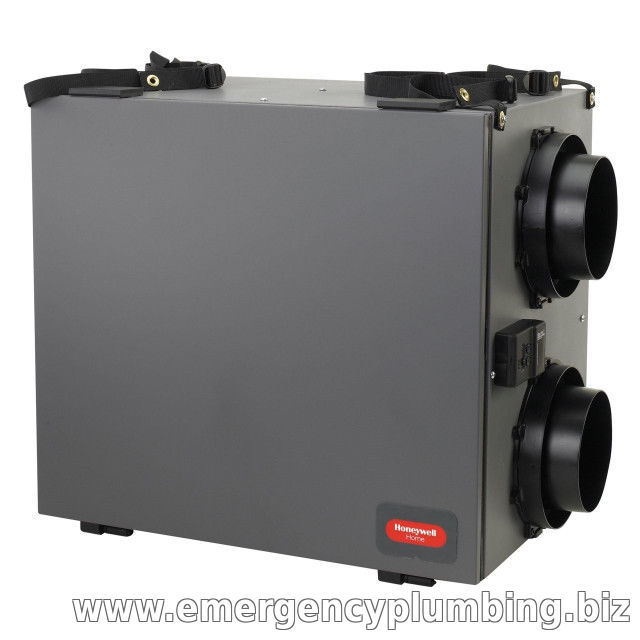
Honeywell 70 CFM Energy Recovery Ventilator
(ERV) VNT5070E1000/U
Product Description
The Energy Recovery Ventilator provides fresher replacement air while recovering up to 70 percent of the exhausted air's sensible heat, as well as some of the latent heat, by transferring moisture from one air stream to the other. The system draws outdoor air through the ventilator for distribution throughout the house, while stale air is exhausted outside.
With removable duct collars, damperless balancing and compact size, the TrueFRESH® system eliminates the need for overhead ducts and time-consuming installation. Provide homeowners with better indoor air quality through high performance and efficiency with the TrueFRESH® Energy Recovery Ventilator.
- BAir flow capacity: 70, 150 and 200 CFM
- Exchange surface: 104 square feet
- Balanced ventilation with sensible and latent heat recovery
- Removable duct collars for simplified ducting
- Intuitive balancing via two variable speed motors and an integrated speed control
- Simplified hanging via adjustable straps
- Compact and light weight design
- Washable ERV core
- Tested for cold weather (down to 5°F/-15°C)
- Automatic defrost
- 5-Year Limited Warranty
Product Specifications
- Heat Recovery Method: Cross-flow (Enthalpic)
- Current Draw: 1.5 A
- Includes: Ventilator, Energy Recovery Core, 2 Filters, 4 Round Duct Collars, Installation Kit, Wall Mount Bracket
- Color: Gray
- Ambient Relative Humidity (Min): 0%
- Ambient Relative Humidity (Max): 99%
- ETL Listed: No
- LED Functions: Solid LED indicates limits, Blinking LED indicates speed change
- Ventilation Type: ERV
- Airflow (CFM): 150
- Warranty: 5 Years
- Product Length: 29.5 in, 749 mm
- Product Width: 11.5 in, 295 mm
- Product Height: 22.5 in, 572 mm
- ENERGY STAR® certified: Yes
Understanding Energy Recovery Ventilation (ERV) Technology
What Makes an ERV Different from a Simple Ventilator
Unlike a basic fresh air ventilator that simply pushes outdoor air into your home (see our AprilAire 8145), an Energy Recovery Ventilator (ERV) performs a balanced exchange: it simultaneously brings in fresh outdoor air while exhausting stale indoor air — and in the process, transfers energy between the two air streams before the incoming air ever reaches your living space.
How Sensible and Latent Heat Recovery Work
- Sensible heat recovery — this unit recovers up to 70% of the sensible heat from the outgoing exhaust air, meaning that in winter, cold incoming outdoor air is pre-warmed using heat that would otherwise be lost, and in summer, hot incoming air is pre-cooled
- Latent heat recovery — beyond just temperature, the system also transfers moisture between the two air streams (the "enthalpic" cross-flow core), helping balance indoor humidity rather than simply dumping unconditioned, humidity-mismatched air into your home
This dual recovery is what distinguishes an ERV from a simpler HRV (Heat Recovery Ventilator), which typically only recovers sensible heat without moisture transfer — making ERVs generally better suited to climates with both cold winters and humid summers, like the Chicago area.
Why This Matters for Your HVAC System's Workload
Without energy recovery, introducing fresh outdoor air means your furnace or AC has to do all the work of conditioning that air from scratch — heating freezing winter air or cooling and dehumidifying hot, humid summer air. By pre-conditioning incoming air using energy that's already being exhausted anyway, an ERV significantly reduces the additional load placed on your primary HVAC equipment, which is why ERVs are often paired with the same efficient systems as AccuComfort or Trane XV18 heat pumps for a complete high-efficiency approach.
Cold Climate Performance: Why It Matters Here
This unit is specifically tested for cold weather operation down to 5°F/-15°C, with automatic defrost to prevent the core from icing over during extended sub-freezing conditions — a critical feature for reliable operation through Illinois winters, where a non-cold-rated ERV could freeze up and stop functioning during the coldest stretches of the season.
Installation-Friendly Design Features
- Removable duct collars — simplify connection to existing ductwork without requiring extensive custom fabrication
- Damperless balancing with two variable speed motors — allows precise airflow balancing between the intake and exhaust streams without manual dampers that can drift out of adjustment over time
- Compact, lightweight design with adjustable hanging straps — eliminates the need for elaborate overhead ductwork or structural support, easing installation in tight attic or mechanical room spaces
- Washable ERV core — supports long-term maintenance without requiring core replacement as a routine task
Multi-Speed Airflow Capacity
With rated airflow capacities of 70, 150, and 200 CFM, this unit can be configured to match different home sizes and ventilation requirements — our technicians will determine the appropriate speed setting based on your home's square footage and occupancy.
ENERGY STAR Certification
As an ENERGY STAR certified product, this ERV meets recognized efficiency benchmarks, reflecting genuine energy savings from its heat and moisture recovery capabilities rather than simply moving air without regard to conditioning costs.
Professional Installation Matters
Because an ERV needs to be properly balanced between intake and exhaust airflow, correctly integrated with existing ductwork, and calibrated for your home's specific needs, professional installation is essential to realizing its full efficiency benefits. Our licensed HVAC technicians will:
- Determine correct sizing and airflow setting (70/150/200 CFM) for your home
- Install and balance intake and exhaust ductwork using the removable duct collars
- Mount the unit securely using the adjustable strap system
- Verify proper defrost operation for winter reliability
- Walk through core cleaning and filter maintenance schedules
ERV vs. Fresh Air Ventilator vs. HRV: Quick Comparison
| AprilAire 8145 (Fresh Air Ventilator) | Honeywell 70 CFM ERV | Typical HRV | |
|---|---|---|---|
| Air exchange type | Supply-only (positive pressure) | Balanced (supply + exhaust) | Balanced (supply + exhaust) |
| Energy recovery | None | Sensible + latent (heat + moisture) | Sensible heat only |
| Best for | Simple, budget-friendly fresh air needs | Humid/cold climates needing full energy recovery | Drier climates prioritizing heat recovery without moisture transfer |
Frequently Asked Questions
Will this ERV work in an unheated attic during Illinois winters?
Yes — it's specifically rated for operation down to 5°F/-15°C with automatic defrost, making it suitable for typical unconditioned attic installations in this climate.
How often does the core need cleaning?
The washable ERV core should be inspected and cleaned periodically as part of routine HVAC maintenance; our technicians can recommend a schedule based on your home's air quality and usage.
Can I adjust the airflow speed after installation?
Yes — the integrated speed control and variable speed motors allow airflow adjustments between the unit's rated CFM settings as needed.
Balanced Fresh Air Ventilation with Advanced Energy & Moisture Recovery
The Honeywell 70 CFM Energy Recovery Ventilation (ERV) System is a compact, high-efficiency mechanical ventilation solution designed to introduce continuous fresh outdoor air while recovering energy and moisture from the exhaust air leaving your home. In tight, energy-efficient modern homes, balancing fresh air intake with climate control is essential. Unlike standard ventilators that dump unconditioned air indoors, Honeywell's advanced enthalpy core transfers both heat and humidity between incoming and outgoing air streams. In the winter, it captures escaping heat and moisture to keep incoming air warm and humid; in the summer, it pre-cools and dehumidifies incoming humid air before it reaches your air conditioner. Call our certified HVAC specialists at (224) 754-1984 for expert ERV installation, ductwork balancing, or indoor air quality upgrades:
Advanced Enthalpy Core Technology: Efficiently transfers both sensible heat and latent moisture between air streams to minimize HVAC energy losses.
Balanced 70 CFM Airflow: Delivers precise, continuous fresh air exchange tailored for medium-sized residential homes and apartments.
Reduces HVAC Energy Strains: Pre-conditions incoming outdoor air, lowering the workload on your furnace and central air conditioner year-round.
Controls Indoor Humidity & Pollutants: Flushes out stale air, volatile organic compounds (VOCs), and cooking odors while preventing excessive winter dryness or summer humidity spikes.
Quiet, Compact Engineering: Designed for flexible wall or ceiling mounting in utility rooms, basements, or mechanical closets with whisper-quiet operation.
Honeywell 70 CFM ERV System Technical Specifications
Designed for efficient residential whole-home balanced ventilation:
Technical Parameter Feature & Specification Details Operational Advantage Manufacturer & Model Honeywell 70 CFM Energy Recovery Ventilator (ERV) Compact balanced fresh air system with core energy transfer. Airflow Capacity 70 CFM (Cubic Feet per Minute) continuous ventilation Ideal for homes up to typical residential size requirements. Core Type Cross-flow Enthalpy Core Transfers heat and moisture simultaneously without cross-contamination. Duct Connections Standard 4-inch or 5-inch duct collars Seamless integration with flexible or rigid residential duct runs. Electrical Requirements 120 VAC, 60 Hz (Standard plug-in or hardwired) Low power consumption for continuous energy-saving operation. Defrost Mechanism Recirculation or intermittent damper defrost Prevents core freeze-up during harsh sub-zero Chicagoland winters.
Key Benefits of Upgrading to a Honeywell Energy Recovery Ventilator
Integrating a Honeywell 70 CFM ERV into your home infrastructure delivers exceptional year-round benefits:
Year-Round Energy Savings: By reclaiming thermal energy from exhausted air, your furnace and AC don't have to work overtime to condition fresh intake air.
Maintains Balanced Home Humidity: Unlike HRVs that only transfer heat, ERV enthalpy cores help retain balanced indoor humidity during dry winter months and reject humidity during humid summers.
Superior Indoor Air Quality: Dilutes indoor contaminants, carbon dioxide, and allergens, ensuring a clean, breathable breathing environment for your family.
Prevents Window Condensation: Keeps indoor moisture levels properly regulated to eliminate foggy windows and mold risks in tight living spaces.
Our Step-by-Step Honeywell ERV Installation Process
Home Airflow & Layout Assessment: Evaluating home square footage, duct layout, and structural space to determine optimal placement for the ERV unit.
Core Vent & Exterior Hood Routing: Core-drilling exterior walls and installing weather-resistant intake and exhaust hoods with insulated ductwork.
Unit Mounting & Duct Connection: Securely hanging the compact ERV chassis and fastening supply, return, fresh air, and exhaust ducts to the unit collars.
Electrical & Wall Control Wiring: Connecting low-voltage control wires to a dedicated wall switch or integrating the ERV with your central thermostat.
Balancing & Commissioning Test: Calibrating fan speeds, verifying proper airflow rates across all channels, and testing full operational cycles.
Frequently Asked Questions: Honeywell 70 CFM ERV System
Q: What is the difference between an ERV (Energy Recovery Ventilator) and an HRV (Heat Recovery Ventilator)?
A: While both provide fresh air, an HRV only transfers heat between air streams. An ERV (Energy Recovery Ventilator) transfers both heat and moisture, making it superior for homes because it prevents indoor air from becoming excessively dry in the winter and helps control humidity in the summer.
Q: Will a 70 CFM ERV be enough for my entire house?
A: A 70 CFM system is ideal for apartments, condos, or medium-sized residential homes. Our technicians perform a thorough airflow calculation to ensure the unit matches your specific home volume and building code requirements.
Q: Does the ERV increase my utility bills?
A: The ERV uses very little electricity to run its internal fans (comparable to a standard light bulb). Furthermore, because it recovers energy from outgoing air, it actually lowers your overall heating and cooling energy consumption.
Q: What maintenance does a Honeywell ERV require?
A: Regular maintenance includes inspecting and cleaning or washing the internal enthalpy core and washable air filters every 6 to 12 months to ensure peak airflow efficiency.
💡 Рекомендации по оптимизаци
Honeywell International Inc. is an American publicly traded, multinational conglomerate corporation headquartered in Charlotte, North Carolina. It primarily operates in four areas of business: aerospace, building automation, performance materials and technologies (PMT), and safety and productivity solutions (SPS). Honeywell is a Fortune 500 company, ranked 115th in 2023. In 2023, the corporation had a global workforce of approximately 95,000 employees. The current chairman is Darius Adamczyk and the chief executive officer (CEO) is Vimal Kapur.
The corporation's current name, Honeywell International Inc., is a product of the merger of Honeywell Inc. and AlliedSignal in 1999. The corporation headquarters were consolidated with AlliedSignal's headquarters in Morristown, New Jersey. The combined company chose the name "Honeywell" because of the considerable brand recognition. Honeywell was a component of the Dow Jones Industrial Average index from 1999 to 2008. Prior to 1999, its corporate predecessors were included dating back to 1925, including early entrants in the computing and thermostat industries.
In 2020, Honeywell rejoined the Dow Jones Industrial Average index. In 2021, it moved its stock listing from the New York Stock Exchange to the Nasdaq.
With multiple locations throughout North Shore and Northwest suburbs of Chicago, Illinois, Emergency Plumbing offers promt and professional plumbing services.
Are you looking for a reliable plumber near me in the Arlington Heights, Bannockburn, Barrington, or surrounding areas?
Our local plumbing company offers expert services, catering to all your needs. Whether you're in the heart of Buffalo Grove, the serene streets of Deerfield, or require an emergency plumber in Des Plaines or Elk Grove Village, we are here to help. Our plumbing contractors are well-versed in the unique plumbing systems of Glencoe, Glenview, Hawthorn Woods, and Highland Park.
For those in Highwood, Hoffman Estates, or the quaint town of India Creek, our team guarantees prompt and efficient service.
Residents of Inverness, Kildeer, Lake Bluff, Lake Forest, and Lake Zurich can also rely on our expertise. We extend our services to Long Grove, Mettawa, Lincolnshire, Mount Prospect, Mundelein, Northbrook, and Palatine.
Need a plumber in Prospect Heights, Ravinia, RiverWoods, Rolling Meadows, Vernon Hills, Wauconda, Wheeling, Wilmette, or Winnetka? Look no further! As a trusted plumbing contractor, we ensure that your plumbing issues are solved quickly and efficiently, keeping your home or business running smoothly.