
One of the most destructive elements to a house is water damage. Water can weaken materials, cause staining, and turn a small problem into a major repair. In fact, for every fifty homeowners, one will submit a claim for water damage every year. Water pouring out from a ruptured main or seeping from a loose fitting or gasket can quickly damage the interior of a house. Even if the leak seems minor at first, the effects often show up later as warped floors, bubbling paint, or lingering odors.
Whenever there is unwanted water in your home that can’t be cleaned with a towel or two, you begin to understand that you need help. The challenge is knowing what kind of help to seek. Should you call a plumber, a restoration service, or both? And what is the difference between plumbing and restoration services in real life? To make the decision easier and help you respond in the right way, we’ll break it down and show how to match the service to the situation.
While restoration and plumbing services complement each other, they are vastly different. The most significant difference is the extent of the damage and the seriousness of the situation. Typical plumbing issues, such as a leaking toilet seal or a clogged pipe, are focused on the source of the problem. In many cases, once the water flow is corrected, the immediate cause is resolved and the situation stabilizes quickly. Those types of repairs are often handled within a few hours, depending on access and what the technician finds.
Restoration is different because it addresses what happens after water has entered your home. Issues like mold remediation, damaged drywall, or problems with a flooded basement are rarely solved by stopping the leak alone. Moisture can hide behind walls, under flooring, and within insulation, which means the impact may continue even after the water is no longer actively coming in. That’s also why timing matters: the sooner you respond, the better your chances of limiting spread and reducing the overall scope of repairs. It’s important to act quickly as soon as you discover a problem, but the first step is to stop and take a breath. Assess what you’re dealing with and identify what’s happened.
As you evaluate the situation, consider the full picture. If you only have an obstruction or a fixture that is actively leaking, you may be dealing mainly with plumbing. But if you see signs of saturation, you notice materials swelling, you smell mildew, or you realize water has been present long enough to cause secondary damage, you likely need more than plumbing can provide. It’s quite possible you need help from both sides. That is when a restoration company can step in—helping manage the damage that water has already done, while a plumber handles the source so the problem doesn’t return.
THE 24-48 HOUR MOLD WINDOW
One of the most important facts to understand about water damage: mold growth can begin within 24 to 48 hours of a surface staying wet. This is why response time matters so much — a leak that's addressed and dried promptly may never develop a mold issue, while the same leak left unaddressed over a weekend can require significantly more extensive remediation. If you've experienced any water intrusion, treating the first two days as a critical window — not something to schedule "whenever's convenient" — can make a meaningful difference in the scope of repairs needed.
CATEGORIES OF WATER DAMAGE
Restoration professionals typically classify water damage by its source, since this affects both the cleanup approach and health considerations:
- Category 1 (Clean water) — from a supply line break or similar clean source; lowest risk, but can still cause structural damage and progress to a more contaminated category if not addressed quickly
- Category 2 (Gray water) — contains some contamination, such as water from a washing machine or dishwasher overflow; requires more careful handling
- Category 3 (Black water) — grossly contaminated water, such as sewage backup or flooding from outside the home; requires the most extensive precautions and professional remediation, not DIY cleanup
SIGNS YOU NEED RESTORATION SERVICES, NOT JUST A PLUMBING FIX
- Visible mold or a persistent musty smell, even after the active leak is fixed
- Swollen, warped, or soft flooring, drywall, or trim
- Bubbling or peeling paint
- Water stains that keep reappearing even after surface cleaning
- Water damage that's been present for more than a day or two before discovery
HOW WE COORDINATE PLUMBING AND RESTORATION TOGETHER
Because the plumbing issue and the resulting damage are closely connected, addressing them as coordinated steps — rather than in isolation — helps ensure the problem doesn't recur:
- Stop the source — our plumbers identify and repair the leak, pipe failure, or fixture issue causing the water intrusion
- Assess the damage — our team evaluates the extent of moisture penetration, including areas that aren't immediately visible
- Water extraction and drying — standing water is removed and affected areas are dried using appropriate equipment
- Restoration — damaged materials (drywall, flooring, insulation) are repaired or replaced as needed, addressed further on our Repair & Rebuild Services page
This coordinated approach — handled by Water Damage Restoration alongside our plumbing team — means you're not left managing two separate contractors trying to piece together what happened and why.
Frequently Asked Questions
How quickly should I respond once I discover water damage?
As soon as possible — mold growth can begin within 24-48 hours of a surface remaining wet, so prompt action significantly reduces the scope of restoration needed.
Will my homeowner's insurance cover water damage restoration?
This depends on your specific policy and the cause of the damage — sudden, accidental water damage (like a burst pipe) is often covered, while damage from long-term neglect may not be; we can help document the damage for your insurance claim.
Can I handle minor water cleanup myself, or should I always call a professional?
For small, contained spills addressed immediately, DIY cleanup may be sufficient; but if water has been present for more than a day, has reached wall cavities or flooring, or came from a contaminated source (like sewage), professional restoration is strongly recommended to prevent mold and structural issues.
Fast Emergency Water Damage Restoration Services
Water damage expands rapidly within hours, saturating drywall, warping hardwood floors, ruining carpeting, and creating an ideal environment for toxic black mold growth. Whether caused by a burst pipe, severe storm, or sewer backup, our certified emergency restoration team responds 24/7. Call us immediately at (224) 754-1984 if you experience any of these emergency situations:
Basement Flooding from Sump Pump Failure: Rapid rainwater accumulation due to pump failure, power outages, or frozen discharge lines.
Burst or Leaking Water Pipes: High-volume water saturation spilling into walls, ceilings, and subfloors from broken copper or PEX supply lines.
Raw Sewage Backups: Hazardous wastewater overflowing from basement floor drains, main sewers, or clogged toilets requiring IICRC-certified biohazard sanitization.
Appliance Floods & Leaks: Washing machine hose ruptures, water heater tank bursts, or dishwasher supply line failures dumping tens of gallons onto flooring.
Roof & Storm Water Intrusions: Torrents of rainwater intruding through damaged rooflines, windows, or foundation wall cracks during heavy Chicagoland storms.
Understanding Water Damage Categories & Cleanup Protocols
The restoration protocol depends heavily on the contamination level of the water source affecting your property:
Water Contamination Category Water Source & Origin Sanitation & Cleanup Protocol Required Category 1: Clean Water Burst freshwater supply lines, broken sink faucets, or clean tub overflows. Rapid water extraction, structural drying, and subfloor dehumidification. Category 2: Grey Water Washing machine overflow, dishwasher discharge, or aquarium leaks. Extraction, thorough antimicrobial treatment, and carpet cushion replacement. Category 3: Black Water Raw sewage backups, rising river/surface floodwater, or stagnant water (48h+). Full hazardous material removal, porous material disposal, and deep disinfection.
Advanced Water Extraction & Structural Drying Technology
Standard shop-vacs and household fans cannot pull moisture trapped deep inside wall studs and subfloors. We deploy commercial-grade remediation equipment:
Heavy-Duty Truck-Mounted Water Extractors: Submersible pumps and high-powered vacuum units that remove hundreds of gallons of standing water per minute.
Industrial LGR Dehumidifiers: Low-grain refrigerant units that extract gallons of moisture daily from saturated air, accelerating wall and floor drying.
High-Velocity Air Movers: Commercial air blowers positioned strategically to force dry air across wet carpets, drywall, and structural framing.
Infrared Thermal Imaging Cameras: Moisture detection cameras that locate hidden water pockets inside walls and ceilings without invasive demolition.
EPA-Registered Antimicrobial & Disinfectant Sprays: Hospital-grade sanitizers that neutralize mold spores, bacteria, and sewage pathogens on contact.
Our Step-by-Step Water Damage Cleanup & Restoration Process
Immediate Emergency Inspection & Thermal Mapping: Arriving on-site to stop active water leaks, test moisture levels, and assess structural damage.
High-Volume Standing Water Extraction: Deploying truck-mounted vacuum pumps to extract 99% of standing water from carpets, tile, and concrete floors.
Controlled Demolition & Contaminated Material Removal: Safely removing unsalvageable wet drywall, soaked insulation, and ruined carpet padding.
Structural Drying & Dehumidification: Setting up industrial air movers and LGR dehumidifiers to dry remaining studs, subfloors, and joists completely.
Antimicrobial Sanitization & Final Rebuild: Applying EPA-registered sprays to prevent mold and restoring structural elements back to pre-loss condition.
Frequently Asked Questions: Water Damage Restoration
Q: How long does the structural water drying process take?
A: On average, professional structural drying takes between 3 to 5 days, depending on the volume of water, affected building materials, and humidity levels.
Q: How fast does mold start growing after a indoor flood?
A: Toxic mold spores can begin germinating and spreading inside wet drywall and under carpets in as little as 24 to 48 hours following water exposure.
Q: Do you work directly with home insurance companies in Illinois?
A: Yes. We document all moisture readings, thermal imaging, and damage details, providing itemized reports directly to your homeowners insurance adjuster to simplify claims processing.
Q: Can wet hardwood flooring or carpets be saved after a flood?
A: Hardwood floors and carpets contaminated by clean water (Category 1) can often be saved if professional extraction and dehumidification begin within 24 hours. Materials soaked by sewage (Category 3) must be safely disposed of.
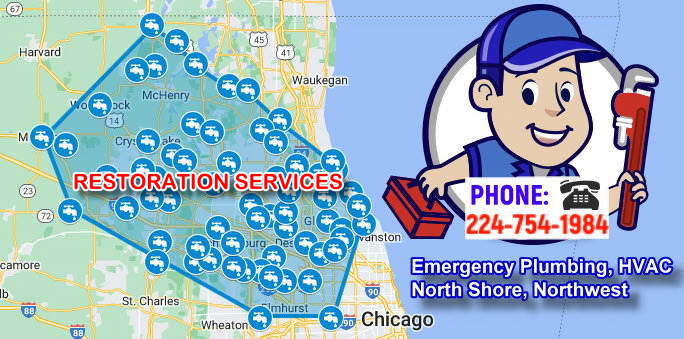
With multiple locations throughout North Shore and Northwest suburbs of Chicago, Illinois, Emergency Plumbing offers promt and professional plumbing services.
Are you looking for a reliable plumber near me in the Arlington Heights, Bannockburn, Barrington, or surrounding areas?
Our local plumbing company offers expert services, catering to all your needs. Whether you're in the heart of Buffalo Grove, the serene streets of Deerfield, or require an emergency plumber in Des Plaines or Elk Grove Village, we are here to help. Our plumbing contractors are well-versed in the unique plumbing systems of Glencoe, Glenview, Hawthorn Woods, and Highland Park.
For those in Highwood, Hoffman Estates, or the quaint town of India Creek, our team guarantees prompt and efficient service.
Residents of Inverness, Kildeer, Lake Bluff, Lake Forest, and Lake Zurich can also rely on our expertise. We extend our services to Long Grove, Mettawa, Lincolnshire, Mount Prospect, Mundelein, Northbrook, and Palatine.
Need a plumber in Prospect Heights, Ravinia, RiverWoods, Rolling Meadows, Vernon Hills, Wauconda, Wheeling, Wilmette, or Winnetka? Look no further! As a trusted plumbing contractor, we ensure that your plumbing issues are solved quickly and efficiently, keeping your home or business running smoothly.