
1:03 AM Tankless vs Storage Water Heaters for Families of Four | |
A family of four typically uses hot water in overlapping routines—morning showers, dishwashing, laundry, and evening cleaning—so the “right” water heater is the one that can keep up reliably. Whether that’s a tankless (on-demand) unit or a storage (tank) heater depends less on marketing and more on your peak usage pattern, fuel availability, and how long you plan to stay in the home.
Below is a practical way to compare both options and identify what best fits common household needs for four people. What changes with a bigger household
For many families of four, the main challenge isn’t total daily hot water—it’s the timing. Short, simultaneous draws (two showers running plus a faucet or dishwasher) can reveal differences in recovery speed. Storage heaters provide hot water steadily until the tank cools, then they refill. Tankless units heat water only when needed, but they must supply enough heating capacity for the flow rate and inlet temperature. Tank size and flow capacity: the core performance test
Storage water heaters are rated by tank volume (commonly 40–50 gallons for many households) and recovery performance, which depends on the burner/element size and incoming water temperature. In contrast, tankless units are rated by maximum flow (e.g., gallons per minute) at a given temperature rise, often paired with the type of fuel (gas vs electric) and the number of available heating stages.
In practice, a storage system may feel more forgiving during peak use because it has a ready “buffer.” A tankless system can work well for families of four when appropriately sized for your busiest simultaneous demand—without that, hot water can drop in temperature or flow. Energy efficiency and operating costs
Tankless water heaters are often more efficient because they heat water on demand and avoid standby heat loss associated with tanks. However, the savings depend on your local utility rates, how frequently you use hot water, and the fuel type. Storage tanks can be efficient too, especially newer models with improved insulation, but they may still lose some heat while waiting to be used.
For households that use hot water more consistently throughout the day, tankless units can offer stronger efficiency gains. For homes with heavy morning peaks and lighter use later, the advantage can depend on recovery rates and how long the unit takes to reheat after a draw. Installation, space, and hot-water availability
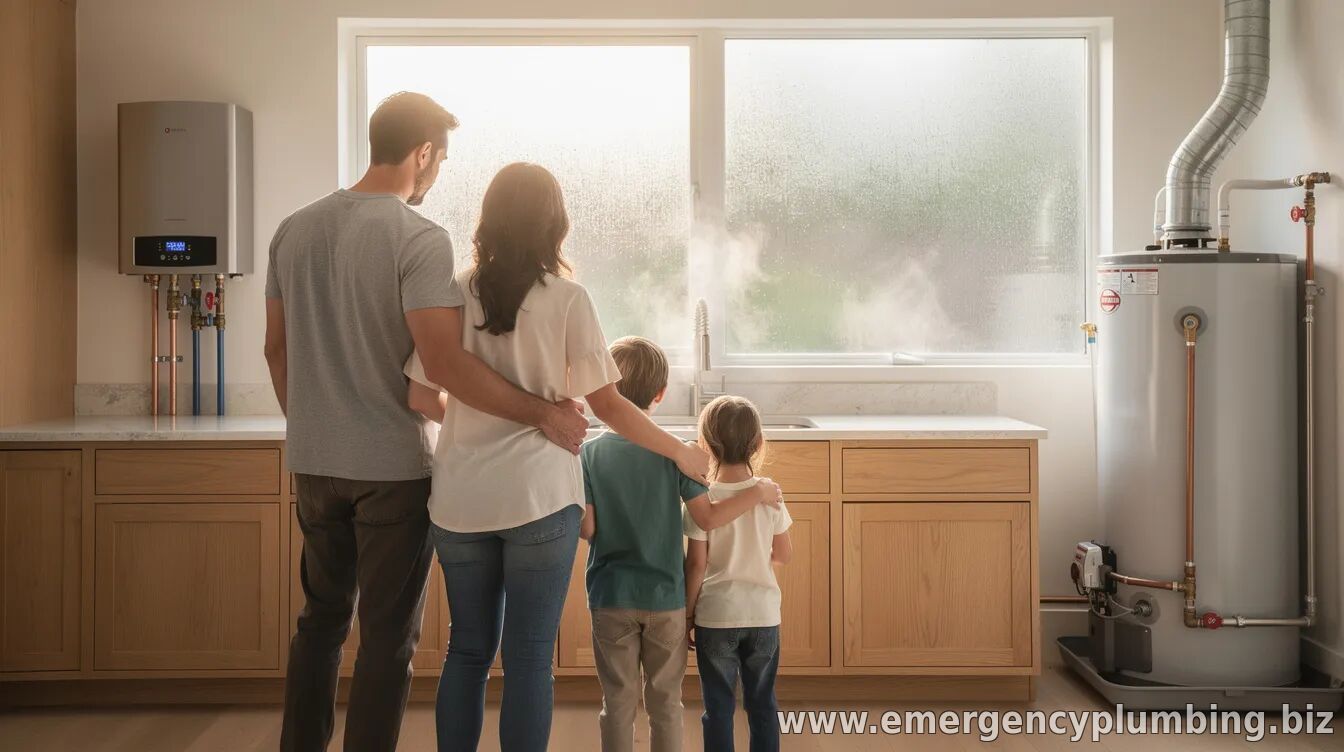
Tankless systems can be attractive where space is limited: many units are wall-mounted and can reduce the need for a large utility footprint. But installation may require upgrades—especially for gas tankless models—such as venting, gas line capacity, and electrical considerations. Storage heaters, by comparison, are usually straightforward to replace in similar-sized spaces, though they still need adequate clearance and a drain pan for safety.
For a family of four, reliability is key: if your home layout allows a tankless unit to serve your whole system efficiently (or you plan appropriately sized units/recirculation), performance is typically easier to manage. If your plumbing layout causes long delays to hot water at the point of use, you may also consider the cost and practicality of hot-water recirculation options. Maintenance and expected lifespan
Both types require maintenance, but in different ways. Storage heaters can be affected by sediment buildup, which can reduce efficiency and recovery. Tankless units may also require maintenance—most notably flushing in areas with hard water to manage scale buildup that can reduce heating performance over time.
When comparing total cost of ownership, factor in not only purchase and install costs but also the likelihood and expense of maintenance, plus the typical service life you expect from each system in your water conditions.
Bottom line: A tankless water heater is often a strong fit for families of four when it’s properly sized for peak simultaneous demand and your household values energy savings and continuous on-demand hot water. A storage water heater may be the better choice when your priority is dependable recovery during rush-hour use, simpler installation, and a proven hot-water buffer.
If you want a clear recommendation, the most useful next step is to measure your likely “peak hour” usage—number of simultaneous showers/faucets and approximate flow rates—then match the heater type to your home’s fuel, space, and water conditions. A qualified plumber or HVAC contractor can size the system accurately and help you avoid under- or oversized capacity.
| |
⏰ Dispatcher support 24/7
📞 224-754-1984CALL ☎ Subscribe 👆 FORUM 🗣
North Shore, Northwest suburbs of Chicago, IL
Next & Previous posts
Related articles: