

1:04 AM Commercial Water Heater Sizing: How to Calculate Needs | |
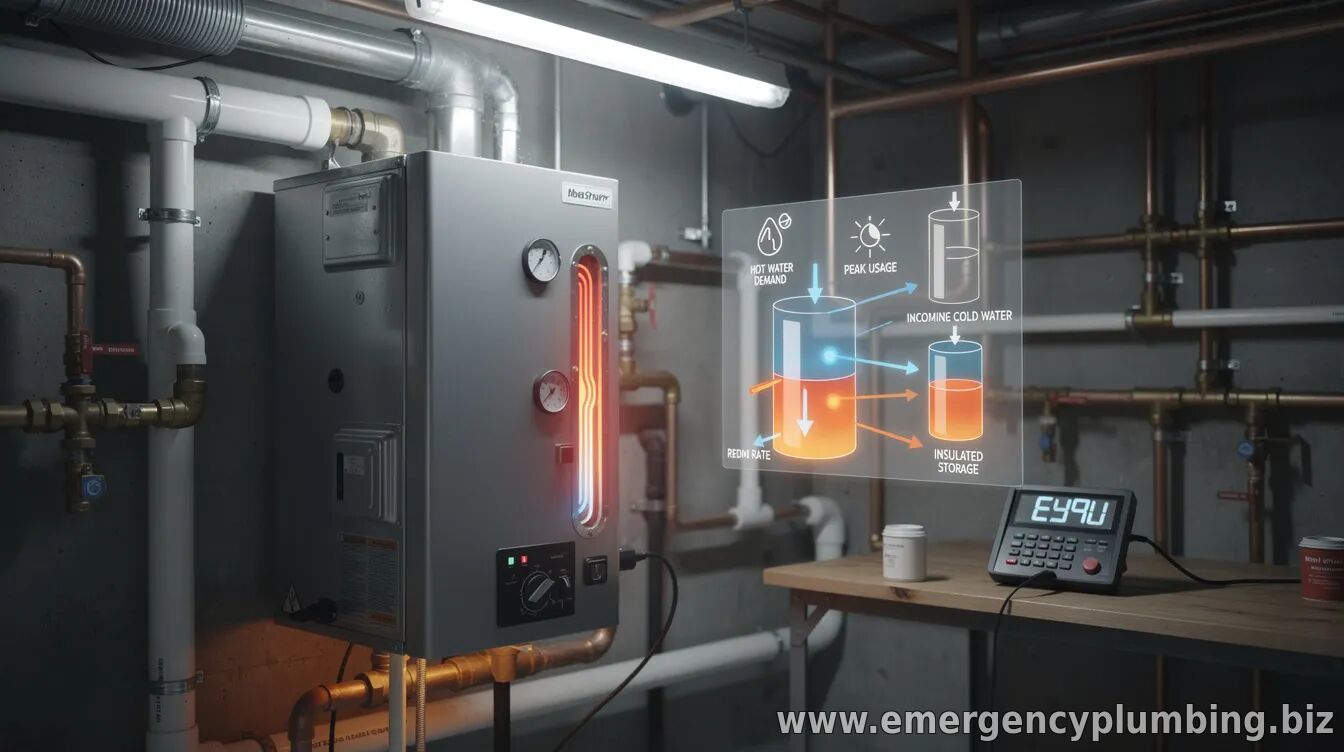
Sizing a commercial water heater isn’t guesswork—it’s a demand-matching exercise. The goal is to ensure the system can deliver hot water during peak use while meeting required temperature settings and recovery performance, without paying for unnecessary capacity.
In practice, the right size depends on how much hot water your building consumes, how quickly it needs to be replenished after draw events, and the required temperature rise (typically from incoming cold water to stored or delivered hot water setpoints). 1) Start with your hot-water demand (fixture and flow estimates)
Commercial sizing typically begins with fixture/unit load data and flow rates. You can estimate demand by adding up the expected usage across sinks, showers, dishwashers, laundries, ice machines, and any other hot-water-connected equipment.
Most methods rely on either:
Be sure to account for diversity/simultaneity—how many fixtures are likely to be used at the same time during the building’s peak period. 2) Calculate the temperature rise
Next, compute the temperature rise your system must achieve. This is determined by cold-water inlet temperature (which varies by season) and your desired hot-water outlet temperature.
Temperature Rise (°F) = Hot Setpoint − Cold Inlet
Example (typical): If the inlet is 55°F and the setpoint is 120°F, the rise is 65°F. Colder inlet water increases the required heating load; warmer inlet water reduces it. 3) Convert demand into heating energy (gallons × temperature rise)
Once you know hot-water demand, you can estimate the energy required to raise that water temperature. A widely used conversion is that one gallon of water requires about 8.33 Btu per degree Fahrenheit.
Approximate Heating Load (Btu) = Gallons × 8.33 × °F Temperature Rise
If you’re estimating per hour, you can express the load as Btu/hr, which aligns well with heater ratings. 4) Determine recovery needs (time between draws)
Even if a tank has enough stored capacity, performance can still fall short if recovery is too slow for your draw schedule. Recovery is especially important in facilities with frequent hot-water usage (e.g., restaurants during service hours, gyms, multi-tenant buildings, or hotels with peaks).
For tank systems, confirm the recovery rate (how quickly the heater can reheat stored water). For tankless systems, verify flow rate at the required temperature rise and the unit’s ability to handle peak simultaneous demand.
A practical approach is to estimate whether the system can restore hot-water availability within the time between peak draw events. If not, you may need more capacity, additional units, higher input energy, or better staging/controls.
Key sizing question: Can the heater deliver peak demand and then recover fast enough for the next peak window? 5) Apply safety, controls, and real-world considerations
Commercial hot-water systems also need to factor in installation realities and operating requirements:
In some facilities, recirculation may be continuous, scheduled, or demand-based. Whatever you choose, include estimated heat loss so the heater can maintain temperatures without undersizing.
Also consider that local codes and manufacturer instructions often influence minimum temperatures, sizing practice, and required safety devices. 6) Choose a sizing method aligned to your equipment type
Different heater technologies are sized differently, so match your calculation to the equipment:
If your building has highly variable demand, parallel staged units with smart controls can reduce oversizing and improve reliability. 7) Final check: does the system meet peak and recovery?
Before you lock in a final size, run the following verification logic:
When these checks align, you’re much more likely to avoid common failure modes such as lukewarm water during busy periods, rapid short-cycling, or paying for capacity you don’t actually need.
For complex facilities (multi-tenant buildings, large hospitality operations, or systems with unusual equipment loads), it’s often worth having a licensed mechanical contractor or engineer validate the load calculation and equipment selection against local codes and design standards.
| |
⏰ Dispatcher support 24/7
📞 224-754-1984CALL ☎ Subscribe 👆 FORUM 🗣
North Shore, Northwest suburbs of Chicago, IL
Next & Previous posts
Related articles: