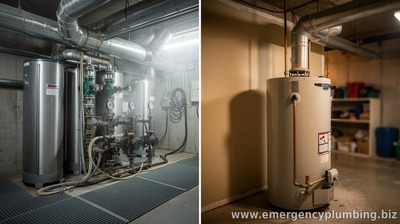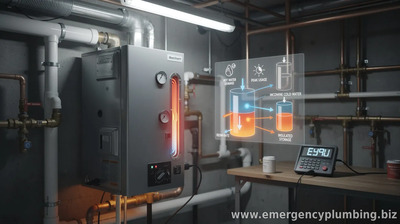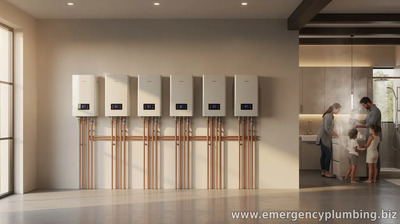


2:09 AM Tankless Water Heater Sizing: How Many GPM Do You Need? | |
Tankless water heaters don’t store hot water like traditional tanks. Instead, they heat water on demand, so the key sizing metric is how much hot water the system can deliver—measured in gallons per minute (GPM). If you pick too small a unit, you may notice lukewarm water or reduced flow when multiple fixtures run at once.
To size a tankless heater correctly, you need two things: your expected hot-water demand (how many fixtures are running and for how long) and the temperature rise (how much hotter the water must be heated compared with your incoming supply). 1) Start with your temperature rise
Temperature rise is the difference between your desired outlet temperature and your incoming water temperature. A common target for showers and dishwashing is ~120°F (to reduce scald risk). If your incoming water is, for example, 55°F in winter or 70°F in milder climates, your temperature rise would be 65°F or 50°F respectively.
Many tankless manufacturers publish flow ratings tied to specific inlet and outlet temperatures. Always check the unit’s rated conditions, because a heater’s real-world GPM can drop significantly when the temperature rise is higher. 2) Estimate your hot-water GPM demand
Next, estimate how many fixtures you expect to use simultaneously. Each fixture has a typical flow rate (often listed in product specs for faucets and showerheads). Add the GPMs for the fixtures that might run at the same time.
Here are common rough benchmarks:
For a typical household, the “critical moment” is often a shower running while the kitchen faucet is on, or two showers running back-to-back or at once. Your sizing should match that likely peak demand. 3) Match demand to the heater’s rated GPM (with margin)
Once you’ve summed your expected simultaneous fixture flow, compare it to the tankless unit’s stated hot-water GPM at your temperature rise. If the heater is rated for a certain output at a specific inlet/outlet temperature, that rating may not hold if your incoming water is colder or if you want hotter water.
A practical rule is to size for your peak demand and add a safety margin if you can’t easily predict usage. Undersizing often shows up as reduced flow rates or water that doesn’t reach the set temperature during heavier use. Typical household sizing examples
While every home is different, these scenarios illustrate the logic:
Single shower + kitchen faucet occasionally: You may only need enough capacity for roughly 2.0–3.0 GPM combined, depending on shower type and whether the kitchen faucet is running concurrently.
Two showers at the same time: Many households require capacity closer to ~3.0–5.0 GPM combined, especially if showerheads are high-flow or the inlet water is cold in your area.
Full simultaneous demand (two showers + dishwasher/laundry use): Expect higher GPM requirements. In some homes, a single unit may struggle, and installers may recommend multiple units or different configuration strategies. 4) Know what affects tankless performance
Tankless heaters can be sized correctly on paper and still underperform if key conditions aren’t considered. Common factors include:
5) When to consider multiple units or professional sizing
If your home regularly experiences high simultaneous demand—such as two or more showers running at once—professional load calculations can prevent costly mismatches. A technician can also verify pipe sizing, pressure, venting (for gas), electrical requirements (for electric), and proper placement for best delivery.
For complex homes or unusual fixture mixes, ask about options like multiple tankless units (zoned by bathrooms or floors) or recirculation strategies that reduce wait times without compromising performance.
Bottom line: Determine your estimated simultaneous fixture flow in GPM, calculate your temperature rise, then choose a tankless heater whose rated GPM matches your needs at those conditions. Doing this upfront is the best way to ensure strong hot water when it matters most.
| |
⏰ Dispatcher support 24/7
📞 224-754-1984CALL ☎ Subscribe 👆 FORUM 🗣
North Shore, Northwest suburbs of Chicago, IL
Next & Previous posts
Related articles: